AI Apps 50: SEO & Traffic Analysis of Top Startup AI Tools (2025)
 Ilias Ism
 Sasha
Sasha Hiren
HirenLast updated:
In their recent AI Apps 50 report, a16z analyzed where startups are actually spending their money when it comes to AI tools.

Original tweet: https://x.com/omooretweets/status/1973778394358976912
But which of these tools are winning in organic search?
We pulled Ahrefs data for all 50 companies to see who's dominating SEO, where the traffic is really going, and what strategies are working in 2025's AI tool landscape.
Key Findings
The data reveals some surprising patterns:
- Traffic Leaders: Canva dominates with 342M monthly visits, followed by Grammarly (26.9M) and Midjourney (2.5M). OpenAI, despite being the most talked-about AI company, gets 114M visits - impressive, but not the highest on the list.
- Authority vs Traffic: High Domain Rating doesn't always mean high traffic. Canva (DR 93) and Grammarly (DR 90) efficiently convert authority into visits, while some tools with similar DR scores see 10x less traffic.
- Fast Movers: Newer tools like Cursor (589K monthly visits, DR 84) and Lovable (317K visits, DR 89) are seeing explosive growth despite being relative newcomers. Their traffic charts show near-vertical climbs in recent months.
- Developer Tools Win: Code-focused tools (Cursor, Replit, GitHub Copilot) punch above their weight in SEO, often with leaner teams than consumer-facing competitors.
- Content Strategy Matters More Than Links: Tools with strong product-led content strategies and use-case pages consistently outperform those focused primarily on link building.
Why This Matters

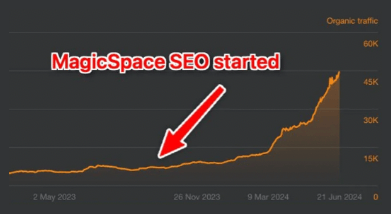
At MagicSpace SEO, we help SaaS companies grow their organic traffic using proven SEO strategies for AI startups.
Understanding what's working for the top AI tools gives us insight into what drives real search visibility in competitive markets.
This analysis breaks down the SEO performance of every tool on the a16z list - traffic, keywords, domain authority, and top pages - so you can see what separates the leaders from the laggards.
Follow us at x.com/illyism, x.com/magicspaceseo, x.com/SashaMagicSpace, x.com/thehirenthakkar for more content like this. Report created with Ahrefs data.
Top 50 AI Tools ranked by SEO traffic

👉 Here is the Google sheet:
- https://docs.google.com/spreadsheets/d/1YDaxMrhfns_B1ieG_OTYzaXD6Fl9OmnZvAT4xJ4oHlQ/edit?usp=sharing
- Please link to this report if you share it!
It includes their total traffic, total amount of keywords, their SEO traffic value in $, how much they spend on paid ads and more!
Here is our analysis of it:
Total Market Analysis - The Big Picture

Combined these 50 tools:
- Rank for 10.6M keywords
- Generate 595M monthly visits
- Worth $73.5M in traffic value
- Have 1.6M total backlinks from 476K referring domains
The Concentration Problem

Top 3 tools (Canva, Grammarly, OpenAI) = 65% of ALL traffic
- Canva: 145M (24%)
- OpenAI: 116M (19%)
- Grammarly: 30M (5%)
- Remaining 47 tools fight over 35% of traffic
The insight: AI tool market is HEAVILY concentrated. If you're not top 3 in your category, you're scraping for leftovers.
Paid vs Organic Disconnect
Total paid search (Google ads) spend across all 50 tools: ~$268K/month
But they're getting $73.5M in organic traffic value!
- ROI ratio: 274x (organic value vs paid spend)
The insight: Even these well-funded tools barely use paid search. Organic is the only sustainable acquisition channel at scale, something we also see with our clients.
The Keyword Bloat Problem

10.6M total keywords but most traffic comes from <1000 high-volume terms
Example:
- Grammarly ranks for 665K keywords
- But top 100 keywords drive ~80% of their traffic
The insight: Most tools waste resources chasing long-tail keywords that generate 1-2 visits/month. Focus on the 1-5 keywords that matter.
👉 Use our Blitz SEO framework to do this.
Geographic Arbitrage at Scale

Looking at "Top Country" column - massive India/US split:
- India-heavy tools: Lower cost per visit but higher volume
- US-heavy tools: Higher cost per visit but better monetization
The pattern: B2C tools go global (more volume), B2B tools stay US-focused (better conversion).
The Paid Search Winners vs Losers
- Grammarly: $93.6K paid spend with 30M organic visits = Still needs paid
- Freepik: $69 paid spend with 52M organic visits = Organic converts well
The insight: If you're spending >$10K/month on ads with massive organic traffic, your organic doesn't convert. That's a product problem, not a marketing problem.
Tldr: Combined, these 50 AI tools generate 595M monthly visits worth $73.5M.

But the distribution is brutal:
- Top 10 tools: 85% of total traffic
- Middle 20 tools: 13% of total traffic
- Bottom 20 tools: 2% of total traffic
The lesson: Being "on the list" doesn't mean you're winning.
You're either top 10 in your category, or not! SEO is more brutal than ever.
Here is the full analysis and SEO strategies for each of the 50 AI startups 👇
OpenAI


DR: 92 | Traffic: 114M | Keywords: 380K
The ChatGPT maker dominates through pure brand strength. Their traffic exploded from near-zero to 114M monthly visits in under 3 years. Top pages include the ChatGPT interface itself and API documentation.
What they do well: Product-led growth creates millions of natural backlinks. Their documentation ranks for thousands of technical queries.
SEO Strategy: Minimal traditional SEO needed - the product IS the marketing.
Anthropic

DR: 88-89 | Traffic: 3.2M | Keywords: 24.6K
Claude's maker shows strong technical content strategy. Two main domains (anthropic.com at 3.2M traffic, claude.ai at specific metrics) both rank well.
What they do well: Research papers as content marketing. Technical deep-dives on AI safety attract high-quality backlinks from academic sources.
SEO Strategy: Authority-first approach - fewer keywords but higher intent traffic.


Replit

DR: 84 | Traffic: 335K | Keywords: 13.2K
Online coding platform with impressive developer SEO. Traffic chart shows steady growth without major spikes - sustainable organic strategy.
What they do well: Code templates rank for "how to build X" queries. Community-generated content creates long-tail keyword coverage.
SEO Strategy: Developer-focused content + interactive tutorials = sticky traffic.

Freepik

DR: 93 | Traffic: 6.1M | Keywords: 97.1K
Design asset library successfully integrates AI features while maintaining core search presence.
What they do well: Massive library of downloadable assets = natural landing pages for thousands of design queries. Each asset page is a potential ranking opportunity.
SEO Strategy: Inventory-as-SEO model - every new asset is a new indexed page.

ElevenLabs

DR: 84 | Traffic: 3.8M | Keywords: 85.2K
Voice AI leader with impressive traffic for a relatively new player. Chart shows explosive growth starting mid-2023.
What they do well: "Text to speech" tutorial content. Voice cloning how-tos. API documentation that ranks for developer queries.
SEO Strategy: Ride the wave - voice AI is hot, and they own the category keywords.

Cursor

DR: 84 | Traffic: 589K | Keywords: 25.9K
AI code editor showing vertical growth trajectory. One of the fastest-rising tools on this list.
What they do well: Developer community content. Comparison pages ("Cursor vs VS Code"). Integration tutorials.
SEO Strategy: Target developers where they search - Stack Overflow-style problem/solution content.

Fyxer.ai

DR: 36 | Traffic: 0 | Keywords: 1
Minimal SEO presence despite making the spending list. Shows the gap between product adoption and search visibility.
Opportunity: With only 1 keyword ranking, massive room for growth through basic content strategy.

Lorikeet

DR: 41 | Traffic: 1.9K | Keywords: 55
Early-stage tool with limited search footprint. Low DR suggests newer domain or minimal backlink building.
Opportunity: Customer experience focus could translate to use-case content and testimonial-based SEO.

Micro1

DR: 51 | Traffic: 17.5K | Keywords: 2.9K
AI recruiting platform with moderate SEO traction. Traffic stable but not growing rapidly.
What they do well: Job board pages create natural landing pages. "How to hire X" content.
SEO Strategy: Two-sided marketplace content - appeal to both job seekers and employers.

Notion

DR: 91 | Traffic: 109K | Keywords: 974
Surprisingly low traffic given massive brand recognition. Most traffic likely goes to the app itself rather than website.
What they do well: Template gallery is SEO gold. Each template ranks for specific productivity queries.
Note: Traffic measurement may undercount app-based usage.

Delve

DR: 59 | Traffic: 15.2K | Keywords: 3.6K
Market research AI with decent visibility for a niche tool.
What they do well: Industry-specific content. "Market research for X industry" pages.
SEO Strategy: Vertical-specific approach rather than broad appeal.

Perplexity

DR: 88 | Traffic: 11M | Keywords: 122K
AI search engine with impressive growth. Positioned as ChatGPT alternative for research.
What they do well: Answer-focused content that ranks in Google despite being a Google competitor. Meta play.
SEO Strategy: Be the answer engine, rank in the search engine.

Instantly

DR: 76 | Traffic: 58.1K | Keywords: 11.7K
Cold email platform with solid SEO fundamentals. Traffic declined from peak but still strong.
What they do well: Email deliverability guides. Cold outreach templates. Tactical how-to content.
SEO Strategy: Problem/solution content for sales teams.

Customer.io

DR: 80 | Traffic: 17.5K | Keywords: 4.9K
Marketing automation with mature SEO program. Stable traffic suggests established presence.
What they do well: Integration documentation. "How to connect X to Y" guides. Marketing automation tutorials.
SEO Strategy: Technical documentation as content marketing.

KlingAI

DR: 76 | Traffic: 494K | Keywords: 8.6K
Video generation AI with strong international presence. Traffic spike visible in late 2024.
What they do well: Multilingual content. Video creation tutorials. Template library.
SEO Strategy: Global expansion through localized content.

Retell AI

DR: 66 | Traffic: 4.4K | Keywords: 1.1K
Voice AI platform with modest search presence. Early in SEO journey.
Opportunity: Voice agent use cases. Industry-specific implementation guides.

Canva

DR: 93 | Traffic: 342M | Keywords: 4.3M
Absolute SEO dominance. Design platform with AI features now built in.
What they do well: Everything. Template library, design tutorials, use-case content, tool comparisons.
SEO Strategy: The gold standard - massive content library, strong UX, viral sharing features.

Lovable

DR: 89 | Traffic: 317K | Keywords: 12.3K
App builder with impressive early traction. Traffic chart shows recent explosive growth.
What they do well: Nothing actually, they only rank for their homepage when you exclude “lovable” as keywords

SEO Strategy: Blog posts! Here are their blog posts, but none of them rank really well.
/blog/best-wedding-website-builder- 0 TRAFFIC, 3 KEYWORDS 🤯
/blog/digital-portfolio-website-examples- 0 TRAFFIC, 7 KEYWORDS
/blog/do-you-need-a-cto-as-startup- 0 TRAFFIC, 1 KEYWORD
/blog/what-is-vibe-coding- 0 TRAFFIC, 1 KEYWORD
These are MONEY topics! Wedding websites? Portfolio builders? They're just... sitting there DEAD! They really need to improve this by a lot.

For MagicSpace SEO clients, we focus on content marketing as a main pillar, writing 3-5 extremely high-quality blog posts for only $5k/mo. This helps real users learn to use your platform, you can re-use the content in your social media, in your newsletter, in your help docs and more!
Metaview

DR: 54 | Traffic: 9.2K | Keywords: 2.1K
Interview intelligence platform. Niche focus limits total addressable search volume.
What they do well: Interview question content. Hiring best practices.
SEO Strategy: Own the interview category rather than compete broadly.

Adept

DR: 69 | Traffic: 2K | Keywords: 106
AI agent company with minimal SEO presence. Product-first approach.
Opportunity: AI agent use cases. Automation tutorials. Massive untapped SEO potential.

Glean

DR: 73 | Traffic: 41.8K | Keywords: 5.3K
Enterprise search with solid B2B SEO. Steady traffic growth pattern.
What they do well: Enterprise search challenges content. Integration guides. ROI calculators.
SEO Strategy: B2B long-form content with high commercial intent.

Photoroom

DR: 75 | Traffic: 7.5M | Keywords: 160K
Background removal tool with massive traffic. One of the breakout SEO success stories.
What they do well: Product photography content. E-commerce tutorials. Before/after galleries.
SEO Strategy: Visual-first approach with viral sharing potential.

Solve Intelligence

DR: 27 | Traffic: 1.1K | Keywords: 89
Patent research AI with minimal presence. Highly specialized niche.
Opportunity: Legal tech content. Patent process guides. Industry-specific SEO.

Gamma

DR: 84 | Traffic: 3.7M | Keywords: 73.6K
Presentation AI with strong growth. Alternative to PowerPoint/Keynote.
What they do well: Presentation templates. "How to make X presentation" content.
SEO Strategy: Template library creates thousands of landing pages.

Side note: I’m working on GenPPT since I acquired it a few months ago, going well!


Clay

DR: 75 | Traffic: 186K | Keywords: 33.9K
Data enrichment platform with solid SEO foundation. Steady growth trajectory.
What they do well: Lead generation tutorials. Integration guides. Automation workflows.
SEO Strategy: GTM-focused content for sales teams.

Cluely

DR: 51 | Traffic: 125k
Company information platform with no organic search presence. Brand new or complete SEO gap.
Opportunity: Everything. Starting from zero means quick wins available through basic optimization.

Crosby

DR: 22 | Traffic: 30 | Keywords: 6
Legal AI tool with minimal footprint. Very early stage SEO.
Yeah… I don’t believe they actually are in the top 50! Looks like A16Z probably just decided to sneak one of their portfolio startups in? 😂 But we can tell! Nice try! “SEO Roasted”

Midjourney

DR: 88 | Traffic: 2.5M | Keywords: 45.1K
Image generation leader with strong community-driven traffic. Discord-first approach creates interesting SEO challenges.
What they do well: Community showcase pages rank well. "How to prompt" content. Style guide documentation.
SEO Strategy: Community content as SEO fuel. User-generated galleries create endless indexable pages.

Combinely

DR: 18 | Traffic: 102 | Keywords: 2
Accounting AI with virtually no search presence. Niche product in early stages.
Opportunity: Accounting automation content. "How to automate X accounting task" guides.
🤔 Another one?

Merlin

DR: 71 | Traffic: 266K | Keywords: 49.4K
Browser extension AI assistant with solid growth. Chart shows steady upward trajectory.
What they do well: Chrome extension optimization. "AI assistant for X task" content. Integration tutorials.
SEO Strategy: Browser extension category SEO + use-case content.

Descript

DR: 83 | Traffic: 701K | Keywords: 64.9K
Video editing platform with strong SEO performance. Consistent traffic growth over 3+ years.
What they do well: Video editing tutorials. Transcription use cases. Podcast production guides.
SEO Strategy: Multi-format content (video, audio, text) creates diverse ranking opportunities.

Grammarly

DR: 90 | Traffic: 26.9M | Keywords: 649K
Writing assistant with mature, dominant SEO. One of the best-executed SEO strategies in SaaS.
What they do well: Writing improvement content. Grammar guides. Tone detector tools. Free tools as lead magnets.
SEO Strategy: Educational content at scale + free tool strategy = massive keyword coverage.

Manus

DR: 75 | Traffic: 248K | Keywords: 4K
AI writing platform with decent visibility. Growth pattern shows steady adoption.
What they do well: Writing use cases. Content creation guides. AI writing tutorials.
SEO Strategy: Position as Grammarly alternative while carving out specific niches.

Cognition

DR: 72 | Traffic: 15.2K | Keywords: 1.3K
AI software engineer (Devin) with strong brand buzz but limited SEO. Product-first approach.
What they do well: Technical demos rank well. Engineering content attracts developer audience.
Opportunity: More developer-focused content. "How Devin helps with X" use cases.
Devin


OpusClip

DR: 76 | Traffic: 532K | Keywords: 14K
Video clipping tool with strong performance. Traffic chart shows consistent growth with seasonal spikes.
What they do well: Short-form video content. "How to repurpose long videos" tutorials. Social media optimization guides.
SEO Strategy: Ride the short-form video trend. Content repurposing is a growing search category.

Happyscribe

DR: 76 | Traffic: 883K | Keywords: 49.9K
Transcription service with solid market position. Stable traffic suggests mature SEO program.
What they do well: Transcription accuracy content. Multi-language support. Subtitle creation guides.
SEO Strategy: Accessibility angle + international SEO = broad keyword coverage.

11x

DR: 57 | Traffic: 7.6K | Keywords: 301
AI sales platform with growing presence. Newer player building momentum.
What they do well: Sales automation content. AI SDR positioning. Outbound playbooks.
SEO Strategy: Own the "AI SDR" category before it gets crowded.

Plaud

DR: 67 | Traffic: 77.7K | Keywords: 3.3K
Voice recording hardware with decent search visibility. Physical product + AI angle.
What they do well: Product comparison content. Voice recording use cases. Hardware reviews rank well.
SEO Strategy: Physical product SEO + software integration content.

Serval

DR: 11 | Traffic: 22 | Keywords: 6
Minimal presence. Very early stage or stealth mode operation.
Opportunity: Complete greenfield. Any content investment would show immediate returns.

Ada

DR: 75 | Traffic: 9.5K | Keywords: 2.6K
Customer service AI with established brand but modest organic traffic. Likely relies on paid channels.
What they do well: Customer service automation content. Chatbot implementation guides.
Opportunity: Much lower traffic than domain authority suggests. Content strategy gap.

Otter

DR: 83 | Traffic: 580K | Keywords: 20.7K
Meeting transcription leader with strong SEO foundation. Steady growth over multiple years.
What they do well: Meeting note-taking guides. Remote work content. Transcription accuracy comparisons.
SEO Strategy: Own the "meeting notes" category through comprehensive content coverage.

Alma

DR: 47 | Traffic: 686 | Keywords: 447
Healthcare platform with limited search visibility. Compliance-heavy industry affects SEO approach.
Opportunity: Healthcare-compliant content. Mental health practice management guides.

ApplaudHR

DR: 47 | Traffic: 686 | Keywords: 447
HR platform with similar profile to Alma. Moderate authority, limited traffic capture.
Opportunity: HR best practices. Employee recognition content. Workplace culture guides.

CapCut

DR: 84 | Traffic: 14.9M | Keywords: 366K
Video editing app with massive traffic. TikTok-owned tool benefits from creator ecosystem.
What they do well: Video editing templates. Social media optimization. Trend-based content.
SEO Strategy: Template library + tutorial content = millions of landing pages.

Motion

DR: 80 | Traffic: 287K | Keywords: 28.5K
Calendar AI with strong positioning. Chart shows impressive recent growth spike.
What they do well: Productivity content. Time management guides. Calendar optimization tips.
SEO Strategy: Productivity category leadership through comprehensive how-to content.

Crisp

DR: 88 | Traffic: 24.6K | Keywords: 4.2K
Customer messaging platform with DR of 88.
Opportunity: They need more blog posts

Arcads

DR: 54 | Traffic: 4.8K | Keywords: 1.4K
Video ad creation tool with early traction. Growing steadily.
What they do well: Ad creation tutorials. Video marketing content. UGC guides.
SEO Strategy: Performance marketing content attracts high-intent audience.

Emergent

DR: 69 | Traffic: 15.9K | Keywords: 40
Low keyword count despite decent authority. Focused on specific technical searches.
Opportunity: Broader content strategy could multiply traffic with same authority level.

Read AI

DR: 70 | Traffic: 61.8K | Keywords: 17.2K
Meeting intelligence platform with solid performance. Growing category.
What they do well: Meeting analytics content. Productivity measurement guides. Remote work optimization.
SEO Strategy: Position as Otter alternative with analytics angle.

Tavus

DR: 66 | Traffic: 12.8K | Keywords: 2.8K
Personalized video AI with early-stage SEO. Recent traffic growth visible.
What they do well: Video personalization content. Sales video guides. Outbound video tactics.
SEO Strategy: Own the "personalized video" niche before competition intensifies.

What Separates Winners from the Rest
1. Content Volume Beats Link Building
Tools like Canva (4.3M keywords) and Grammarly (649K keywords) prove that massive content libraries outperform selective high-authority linking strategies. Their template and tool pages create thousands of natural entry points.
The Pattern: Every new template/tool/asset = new indexable page = new ranking opportunity.
We call this Programmatic SEO, and we have a course about it:
2. Developer Tools Win Through Documentation
Cursor, Replit, and Notion show that technical documentation ranks exceptionally well. Developers search for specific implementation problems, and detailed docs answer those queries.
The Pattern: Problem-specific documentation > generic marketing content.
3. Category Leadership Requires Content Ownership
Perplexity (11M visits), Midjourney (2.5M visits), and ElevenLabs (3.8M visits) demonstrate that owning a category's educational content creates sustainable traffic.
The Pattern: "How to use [category]" content > "Why use [our tool]" content.
We focus on this in our pillar posts.
4. Traffic ≠ Domain Rating
Many high-DR tools show surprisingly low traffic. Ada (DR 75, 9.5K traffic) and Crisp (DR 61, 2.2K traffic) have authority but haven't converted it to visitors.
The Lesson: Links without content strategy = wasted authority.
But you still need links, so try LinkDR.
5. Vertical Growth Beats Horizontal Expansion
Tools that go deep in one category (OpusClip for video clipping, Otter.ai for meeting notes) outperform generalists trying to rank for everything.
The Pattern: Own one category completely > weak presence in multiple categories.
And even better, one keyword, this is what we do with our proprietary Blitz SEO framework.
Methodology
We analyzed all 50 tools from a16z's AI Apps Startup Edition report using Ahrefs data pulled on October 3, 2025:
Metrics captured:
- Domain Rating (0-100 authority score)
- Organic keywords (total ranking keywords)
- Monthly organic traffic estimates
- Top-performing pages by traffic
- 5-year traffic trend data
Data accuracy: Rankings fluctuate monthly. This snapshot represents October 2025 performance.
Tools analyzed: Complete list from a16z report including OpenAI, Anthropic, Replit, Freepik, ElevenLabs, Cursor, and 44 others.
Ready to Scale Your SaaS Like These AI Leaders?
The tools dominating this list share one thing: strategic, consistent SEO execution.
At MagicSpace SEO, we help SaaS companies implement the same strategies these AI leaders use to dominate organic search.
See exactly where your SEO stands and what quick wins are available.
Or order a paid SEO roast, just like Cal, Resend, Tolt, Chatbase, Framer did.

Report compiled by MagicSpace SEO | October 2025 | Data via Ahrefs