Programmatic SEO: Ultimate Guide to Scaling SEO
What programmatic SEO is, how it works, real examples and the strategies we use to build thousands of pages that rank.


I run a few programmatic SEO sites myself, and in October one of them lost about 90% of its Google traffic in four days because of a single deploy I made. So this guide is less theory and more about what I've broken and fixed.
Programmatic SEO means you take a dataset, build one page template, and publish a page for every row, where each page targets one search query that a real person types. Think "distracted boyfriend meme generator", a specific hex color, or "connect Slack to Notion". Nobody writes those pages by hand, and nobody should.
What is programmatic SEO?
You look for a search pattern with a fixed part and a variable part, and then you find (or build) data for the variable part.
My gradient site, gradient.page, is the simplest example I have. The fixed part is "gradient" or "hex color" and the variable part is the color itself. Its sitemap lists 1,661 URLs right now, 1,102 hex color pages and 543 UI gradient pages, and I didn't write any of them. A script generated them from a color list and one template with a live preview and CSS you can copy.
What it's not is an excuse to spin up 50,000 thin pages with a city name swapped in. Google got very good at ignoring those after the helpful content updates in 2022 and 2023, which hit a lot of lazy pSEO sites, and AI answers now take most of the easy informational queries anyway. Every page needs something the visitor can use right there, like a working tool, a real data point or an example to copy.
Why bother?
Because long-tail queries add up, and usually nobody else is targeting them.
One meme template page on magicmeme.com gets maybe a few visits a day. There are over 2,000 of them though, and in early October they pulled roughly 1,200 Google visitors a day combined with zero blog posts and zero writers.
The other reason is cost. Once the template works, page 2,000 costs about the same as page 20, so the hard part moves from writing to data quality (which, honestly, is a problem most engineers enjoy more).
How I lost 90% of the traffic in four days
On October 10 I shipped a "cleanup" to magicmeme.com. Two changes:
- The templates index went from listing all 2,126 templates to 72 shuffled cards.
- Every template page got a new title format.
Google visitors per day went from around 1,200 to 752, then 295, then somewhere between 70 and 121 by October 14.
The index page was how Googlebot found most of the template pages, so cutting it to 72 random cards took away the main internal link for the other 2,000+ pages overnight. The shuffle made it worse because every crawl saw a different set. And the new titles dropped the exact phrase people search for, "[template] meme generator".
The fix went live October 15. Every template is listed A to Z on page one again with popular templates first, the old "X Meme Generator | MagicMeme" titles are back, and about 1,100 old tag URLs resolve again. Traffic recovered partly, to around 220 a day by mid-November, but not fully. Google doesn't forget that fast.
I'm not the only one. In the course I tear down Nomad List's move from nomadlist.com to nomads.com, where Ahrefs showed organic traffic going from about 14k to about 5k a month. Most of it came down to broken redirects and a firewall that answered Googlebot with 429 errors while normal browsers loaded fine. The cheapest check you can run is the live test in Search Console's URL inspection, because the screenshot shows what Googlebot actually got.
So in programmatic SEO, your internal links, your title template and your redirects are the product. Touch them carefully.
Programmatic SEO course
I turned the playbook into our programmatic SEO course. It's 54 lessons across 9 modules, with teardowns of how Booking.com, Airbnb and Canva do it, plus our own sites.
You pay once: $149 for the course, $349 if you only want the Next.js boilerplate and scripts, or $499 for both plus a 1:1 call where we look at your niche before you build anything. If you're not sure your niche works for pSEO at all, the call is the part worth paying for.
It's for developers and technical founders. If you've never touched a codebase, start with our Next.js programmatic SEO guide to see if this is your thing.
How to build one, step by step
This is the order I follow now, after getting it wrong a few times.
- Find the pattern. Look for a keyword with a fixed head and hundreds of variations. Check that the variations have real search volume in Ahrefs or Semrush. Ten variations with 20 searches each is a nice feature, not a pSEO project.
- Check the SERP. Search five of the variations. If the results are all forum threads and thin directory pages, good. If it's all AI Overviews answering the question in one line, skip it.
- Get the data. Public datasets, your own product data, an API, or a scrape you clean up. Most of the work is here. Bad data means 2,000 bad pages.
- Build one great page. Make one page by hand that you'd be happy to land on. Then turn it into the template. Not the other way around.
- Link everything. An index page that lists every page (not a random sample, see above), plus related links between pages.
- Ship in batches. Publish 100, wait for indexing, check Search Console, then publish more. Submit the sitemap and use something like TagParrot if indexing is slow.
- Prune. Pages with zero impressions after a few months either get better content or get noindexed. On magicmeme.com 904 of 2,373 templates are noindexed right now, and I promote one back when it starts getting impressions anyway and I've added real content to it.
Real programmatic SEO examples
Some of these are mine, some aren't.
1. MagicBuddy's ChatGPT examples
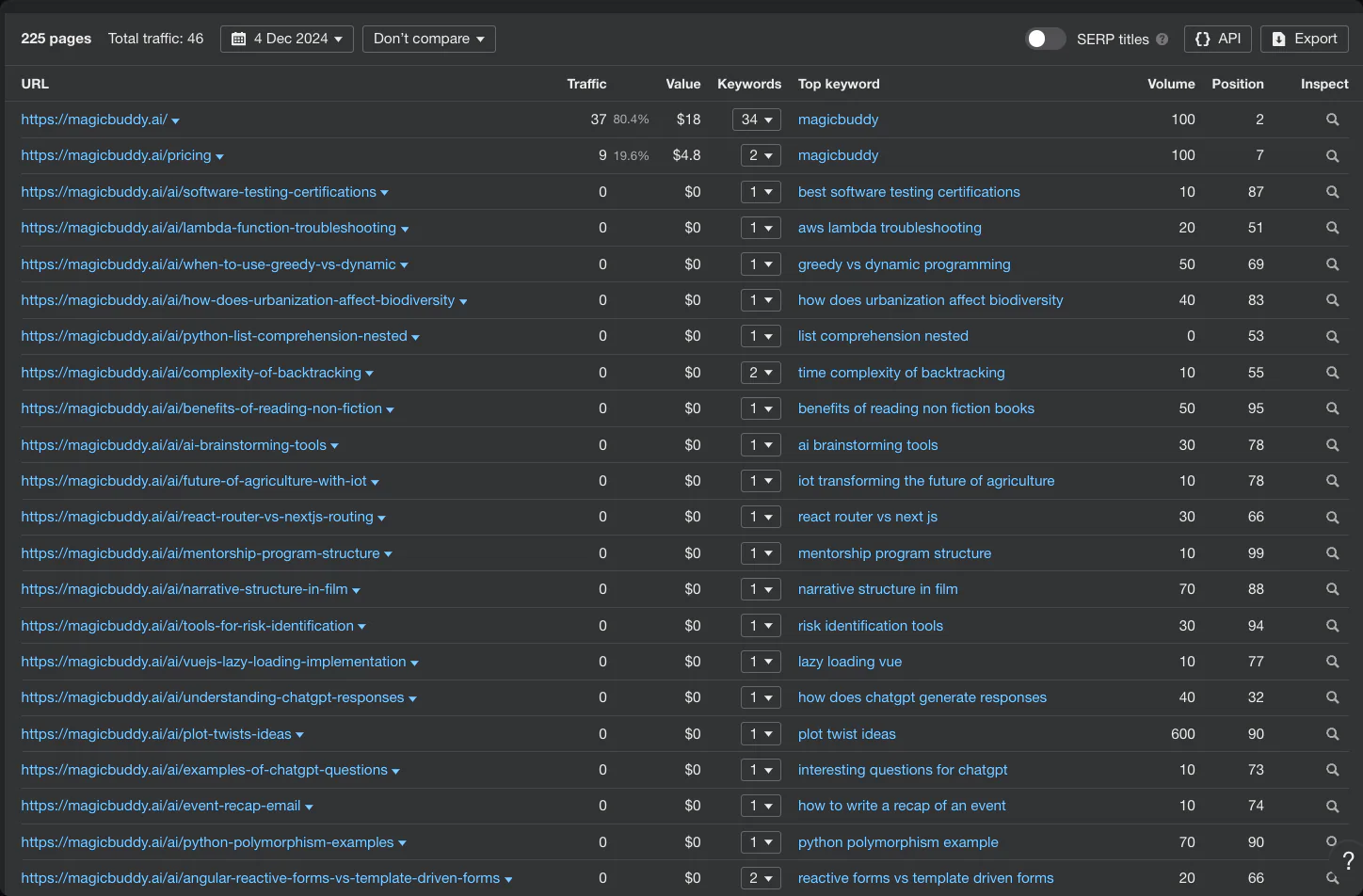
MagicBuddy is our ChatGPT bot for Telegram. It has a page per AI topic under /ai/:topic, each with its own title, description and an example conversation. The example conversation is the useful bit. It shows the visitor exactly what they'd get before they install anything.
2. WorkbookPDF's language workbooks
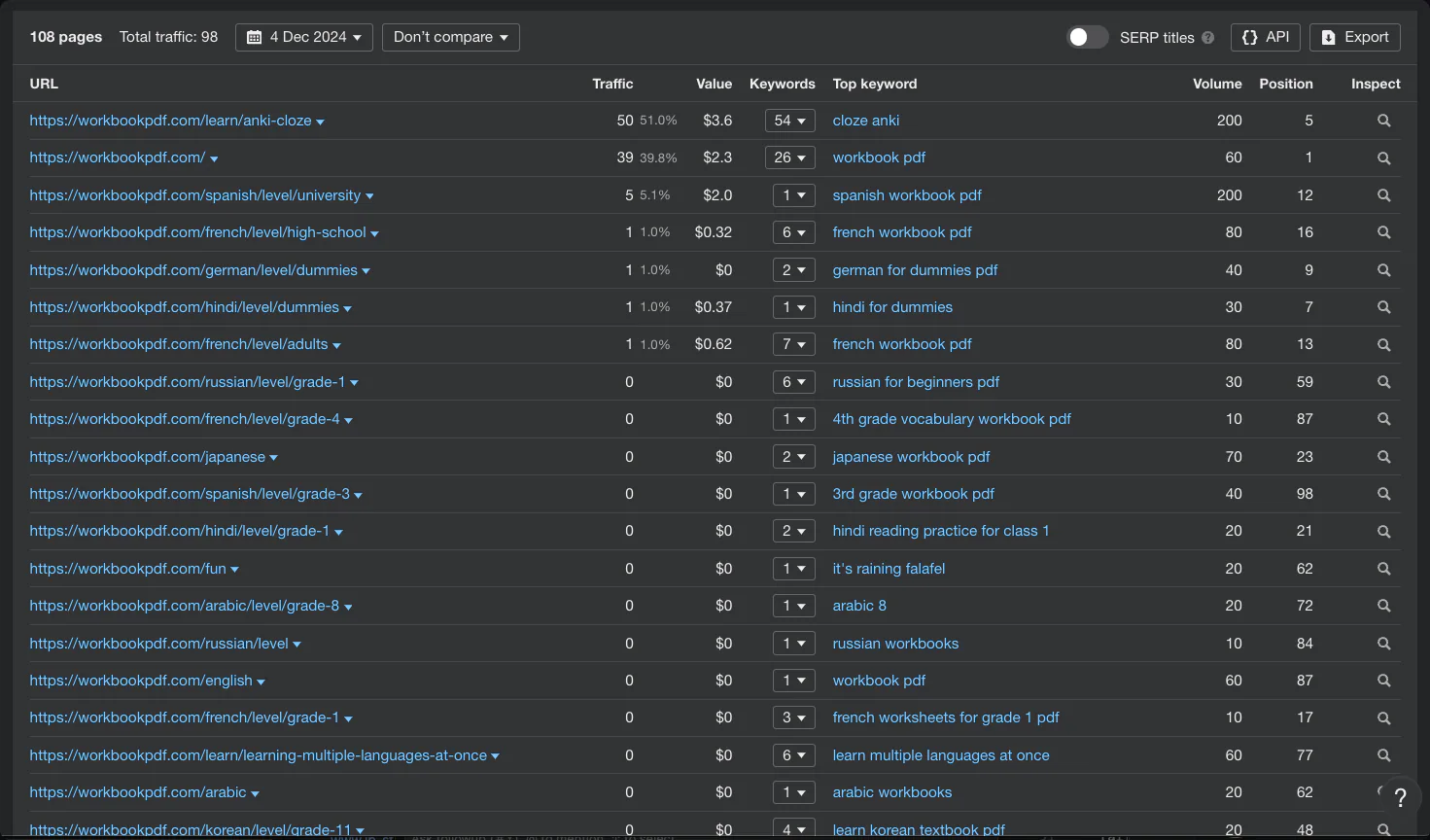
WorkbookPDF isn't ours, but it's a clean example. One page per language level (/korean/level/grade-11) and per topic (/french/topic/wine). Two dimensions, one template, and a real downloadable workbook on each page.
3. GradientPage's UI gradients
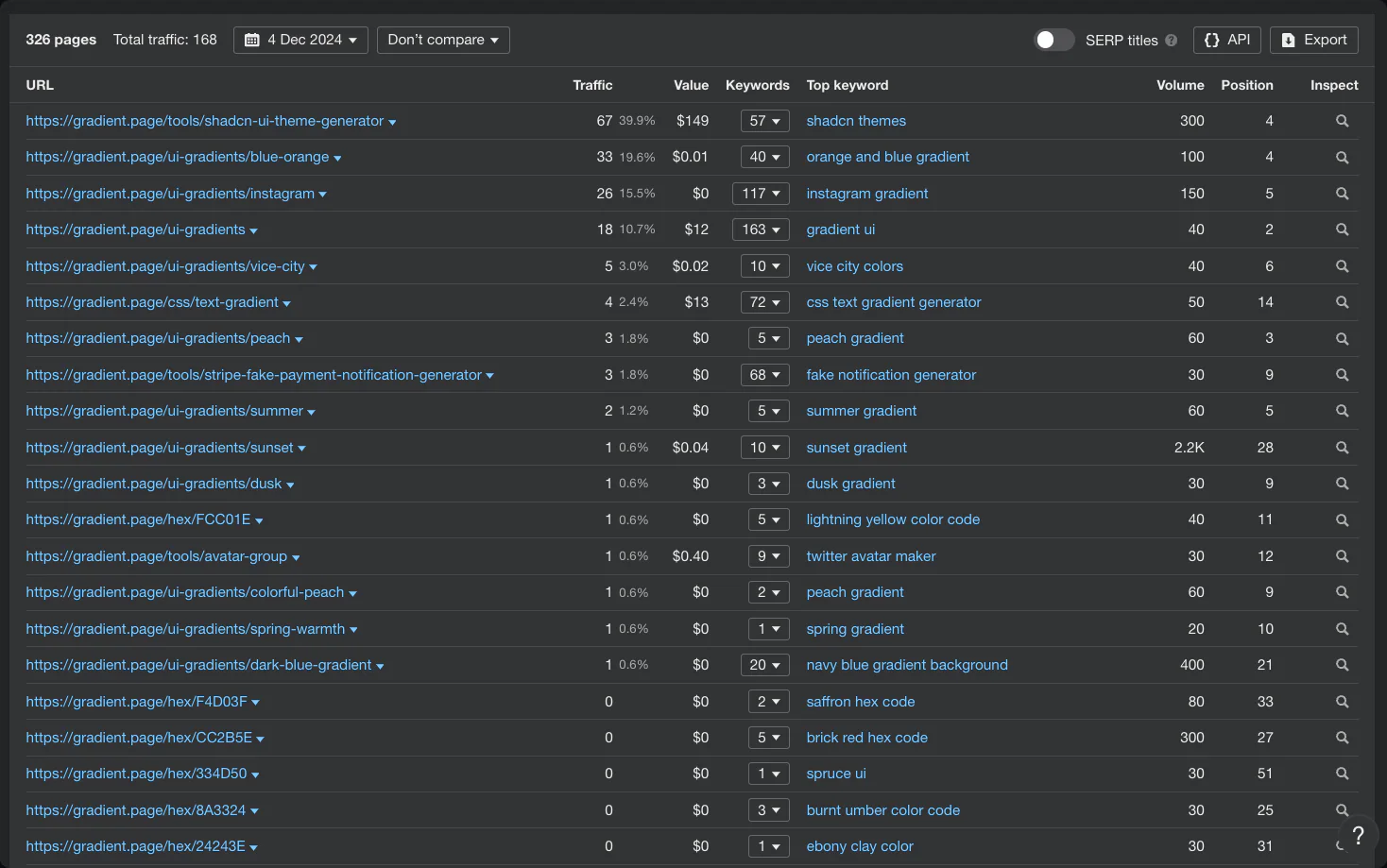
GradientPage is mine. Hex pages and gradient pages, each with a live preview and CSS you can copy. One thing I learned the hard way: Google Images had indexed wallpaper URLs that contained build hashes, so every deploy broke them. We now 308-redirect the old hashed URLs to the stable ones.
4. Other examples worth studying
- Nomad List has a page per city for remote workers, built on cost of living and internet speed data.
- TripAdvisor and Yelp are the classic version: one page per place, per category, per city.
- Zapier has pages for thousands of app pairs, one for every "X to Y integration" query people type.
- awesome.tools (ours) has a page per tool and per "best X" category, with screenshots we take ourselves.
Where to start
Pick one pattern. Build one page you're proud of. Ship 100 and watch Search Console for a month before you ship 10,000.
If you want to build it yourself, the programmatic SEO course has the full system. If you'd rather have a team research, build and ship the pages for you, that's what our programmatic SEO agency does. Not sure pSEO even makes sense for your product? Book a free 15-minute audit.
Programmatic pages also get pulled into ChatGPT and Perplexity answers when they hold data nobody else has. Our AI SEO course covers how to get cited there.

Written by
Ilias IsmIlias is the co-founder of MagicSpace SEO, helping small businesses grow with SEO. With a decade of experience as a CTO and marketer, he offers SEO consulting and SEO services to clients worldwide.
- Built and sold Officient ($500k+ MRR)
- 20+ products generating $10M+ revenue
- 1000+ students taught SEO
MagicSpace SEO, Zug, Switzerland
SEO audits, monthly plans and link building for software companies
Run by the founders, Ilias Ism and Sasha. Rated 5.0 on Clutch.
Or get a recorded SEO audit • Both include next steps and an intro to our services

Keep reading
How to Extract Text From Video: 5 Methods Compared (2026)
How to extract text from video: spoken words and on-screen text need different tools. Five methods compared, with prices and where each one falls short.

Black Friday SEO: How to Rank in 2026
How to rank for Black Friday keywords in 2026: Reddit threads that already rank, evergreen deal hubs and SaleEvent schema.
Content Distribution Guide: Turn 1 Article Into 7X the Reach
Everyone writes blog posts, almost nobody distributes them. Turn one article into a Twitter thread, LinkedIn post, Pinterest pins, Reddit answer, Medium syndication, newsletter and Quora response: same content, 7x the reach.